If you experience a dull, aching pain behind or around your kneecap that intensifies when you run, squat, or walk down the stairs, you might be dealing with a prevalent condition known as runner’s knee. Despite the name, this condition isn’t exclusive to athletes; it is a widespread musculoskeletal issue that affects people of all activity levels.
If left unaddressed, runner’s knee can turn a simple daily walk into a frustrating chore. Fortunately, targeted physiotherapy is widely recognized as one of the first-line conservative treatments recommended for managing this discomfort, helping to address contributing factors and get you back to an active lifestyle.
Below, we break down exactly what runner’s knee is, why it happens, and how expert Physiotherapy Treatment in Winnipeg can support your recovery.
What Is Runner’s Knee?
Runner’s knee is a broad, catch-all term used to describe several injuries and disorders that cause pain around the kneecap (patella). Most commonly, it refers to Patellofemoral Pain Syndrome (PFPS).
The Anatomy Behind the Pain
The kneecap sits at the front of the knee joint within the patellofemoral groove. As you bend and straighten your leg, the underside of the patella is supposed to glide smoothly over the cartilage of your thighbone (femur).
When the patella shifts out of its optimal path, a mechanical issue known as poor patellar tracking causes abnormal friction against the femur. This repetitive stress leads to localized irritation and pain.
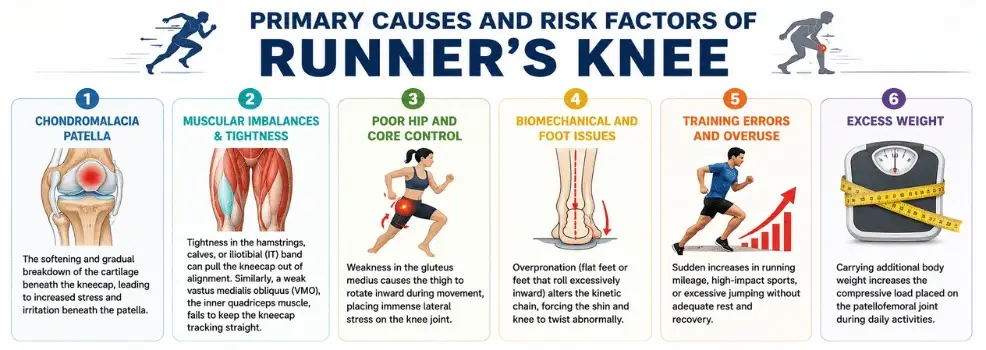
Primary Causes and Risk Factors of Runner’s Knee
Runner’s knee is rarely caused by a single factor; rather, it is usually a combination of multiple contributing biomechanical and muscular factors:
- Chondromalacia Patella: The softening and gradual breakdown of the cartilage beneath the kneecap, leading to increased stress and irritation beneath the patella.
- Muscular Imbalances & Tightness: Tightness in the hamstrings, calves, or iliotibial (IT) band can pull the kneecap out of alignment. Similarly, a weak vastus medialis obliquus (VMO), the inner quadriceps muscle, fails to keep the kneecap tracking straight.
- Poor Hip and Core Control: Weakness in the gluteus medius causes the thigh to rotate inward during movement, placing immense lateral stress on the knee joint.
- Biomechanical and Foot Issues: Overpronation (flat feet or feet that roll excessively inward) alters the kinetic chain, forcing the shin and knee to twist abnormally.
- Training Errors and Overuse: Sudden increases in running mileage, high-impact sports, or excessive jumping without adequate rest and recovery.
- Excess Weight: Carrying additional body weight increases the compressive load placed on the patellofemoral joint during daily activities.
Common Signs and Symptoms of Runner’s Knee
You might be suffering from runner’s knee if you experience:
- A dull pain in the front of the knee, especially where the kneecap meets the thighbone.
- Pain that worsens when walking downhill, descending stairs, squatting, or sitting for prolonged periods (often referred to as the “theater sign”).
- A cracking, popping, or grinding sensation (crepitus) inside the knee joint during flexion.
- A feeling of instability or weakness in the joint.
Note: Because these symptoms can mimic other internal knee injuries like meniscus tears or patellar tendonitis, a professional clinical assessment at Bridgwater Physiotherapy is highly recommended.toms can mimic other internal knee injuries like meniscus tears or patellar tendonitis, a professional clinical assessment is highly recommended.
How Physiotherapy Helps Treat Runner’s Knee
A thorough Knee Physiotherapy Program focuses on structural alignment, functional strength, and tissue mobility to manage symptoms and lower the risk of recurrence.
1. Targeted Strengthening Exercises
To keep the kneecap in its proper groove, the muscles surrounding the hip and knee must be strong and coordinated:
- Quad Sets (Isometric Contractions): Lie flat on your back with your leg straight. Tighten the muscle on the top of your thigh (quadriceps) by pushing the back of your knee firmly down into the floor. Hold for 5–10 seconds. This helps activate the VMO muscle responsible for patellar tracking.
- Straight Leg Raises (SLR): Lie on your back, bend one knee, and keep the affected leg straight. Slowly lift the straight leg about 12 inches off the floor, hold for 3 seconds, and lower it slowly.
- Clamshells: Lie on your side with your knees bent at a 90-degree angle and feet together. Keeping your feet touching, slowly raise your top knee. This targets the gluteus medius to prevent the knee from collapsing inward during movement.
- Short-Arc Quads: Place a rolled towel under your knee and straighten your lower leg upward to target terminal extension strength.
- Step-Ups: Step onto a low platform to build functional eccentric strength for stair navigation.
- Glute Bridges: Lift hips toward the ceiling to engage the posterior chain and offload the knees.
2. Strategic Stretching and Flexibility Routines
Alleviating structural tension reduces the pulling forces acting on the patella:
- Standing Calf Stretch: Face a wall, place one foot back with the heel flat on the floor, and lean forward until you feel a deep stretch in your lower leg. Hold for 30 seconds.
- Seated Hamstring Stretch: Sit on the edge of a chair, extend your injured leg straight out with your heel on the floor, and hinge forward from your hips while keeping your back flat.
- Standing Quadriceps Stretch: Stand on one leg, bring your heel toward your buttock, and gently pull your ankle with your hand. Keep your knees close together to protect the joint.
- IT Band Stretch: Cross the affected leg behind the other and lean your torso away to release outer hip tension.
3. Manual Therapy & Patellar Taping
Physiotherapists utilize specialized manual techniques, including soft tissue mobilization and joint manipulation, to reduce localized stiffness. Additionally, targeted taping methods (such as McConnell taping) may provide short-term pain relief while improving kneecap alignment during physical activity.
4. Biomechanical Corrections
Physiotherapists in Winnipeg may also assess and modify a patient’s running technique and footwear to address and correct biomechanical issues. If structural problems in the foot contribute to undue stress on the knee, custom orthotics might be prescribed to offer additional support and proper alignment.
5. Advanced Modalities for Symptom Management
During the acute, painful phase of recovery, therapists may utilize therapeutic modalities like ultrasound therapy or electrical stimulation. These treatments may help reduce pain and support your broader rehabilitation program, depending on your specific clinical findings.
How Long Does a Runner’s Knee Take to Recover?
Typical recovery timelines vary significantly depending on the severity of your symptoms, your baseline activity level, and your adherence to your home exercise program:
- Mild cases: 2-4 weeks
- Moderate cases: 6-8 weeks
- Persistent cases: 3-6 months
Most individuals experience noticeable improvement with consistent physiotherapy, targeted strengthening exercises, and temporary activity modification.
Start Your Recovery Journey Today
Runner’s knee doesn’t have to permanently keep you sidelined from the activities you love. By addressing contributing biomechanical factors, muscle weaknesses, and joint tightness, you can significantly reduce your pain and safeguard your knees for the long haul.
At Bridgwater Physiotherapy, our team of experienced Winnipeg physiotherapists designs customized recovery programs tailored to your specific movement patterns. [Contact us today] to book your runner’s knee treatment in Winnipeg and take your first step toward an active, comfortable recovery.
Frequently Asked Questions
Can Runner’s Knee Heal Without Physiotherapy?
Mild cases may temporarily improve with rest, ice, and activity modification. However, if the underlying muscle weaknesses or biomechanical alignment issues are not addressed through expert physiotherapy treatment in Winnipeg, the pain is highly likely to return once you resume normal activity levels.
Should I Stop Running Completely?
Not necessarily. While you may need to temporarily reduce your mileage, avoid hills, or modify your training intensity to stay below your pain threshold, complete rest can sometimes lead to muscle deconditioning. A Winnipeg physiotherapist can help determine your safe “zone” for activity.
Is Cycling Okay with Runner’s Knee?
Cycling is an excellent low-impact alternative to running, but seat height is critical. If your bike seat is too low or too far forward, it can increase the compressive forces on your kneecap and aggravate your symptoms.
Can Runner’s Knee Come Back?
Yes, recurrence is common if you stop your strengthening and stretching routines too early. Maintaining core, hip, and quad strength even after you become pain-free with ongoing guidance from Bridgwater Physiotherapy is the best way to lower the risk of recurrence.