
Have you ever felt a sharp twist, a persistent dull ache, or a burning sensation right beneath your shoulder blade?
This specific discomfort, often localized around the scapula, is one of the most common reasons patients seek physical therapy. While it is frequently triggered by a simple postural muscle strain from prolonged desk work or sudden lifting, pain under the shoulder blade can also serve as a referred warning sign for structural spinal issues or, in rare cases, systemic medical emergencies.
Understanding the underlying cause of your scapular pain is essential for finding the right treatment. Let’s break down the seven primary reasons for pain under the shoulder blade, how to identify urgent warning signs, and how evidence-based physical therapy can provide lasting relief.
When Is Shoulder Blade Pain an Emergency?
Because nerves in the thoracic spine share pathways with internal organs, pain near the left shoulder blade can occasionally indicate a cardiovascular or gallbladder issue.
Seek emergency medical attention immediately if your shoulder blade pain is accompanied by:
- Chest pain, pressure, or fullness
- Shortness of breath or difficulty catching your breath
- Pain radiating into your jaw, neck, or left arm
- Sudden dizziness, cold sweats, or unexplained nausea
If you are not experiencing any of these systemic symptoms, your pain is highly likely musculoskeletal in nature and can be safely managed through conservative care.
Scapular Pain Triage: Quick Symptom Guide
| Symptom Presentation | Most Likely Biomechanical Cause | Recommended Action |
| Dull, burning ache after sitting at a desk | Postural fatigue / Rhomboid or Trapezius strain | Implement desk ergonomics and targeted stretches. |
| Sharp pain when taking a deep breath or turning | Rib misalignment / Intercostal muscle strain | Schedule a Chiropractic Care or Physio assessment. |
| Shooting pain, numbness, or tingling down the arm | Cervical herniated disc (Radiculopathy) | Seek a Physiotherapy Evaluation for nerve decompression. |
| Sudden, severe pain following an overhead lift | Acute muscle strain or ligament sprain | Rest, apply ice, and seek professional diagnosis. |
7 Causes of Pain Under Your Shoulder Blade
The scapula relies on a complex network of 17 different muscle attachments to move smoothly against your rib cage. When this delicate mechanical balance is disrupted, pain follows. Here are the seven most common reasons for this disruption:
1. Postural Dysfunction and Muscle Fatigue
Prolonged sitting, slouching forward, and looking down at screens put immense eccentric strain on the upper back muscles (such as the rhomboids, middle trapezius, and levator scapulae). Over time, these muscles overstretch and fatigue, leading to painful myofascial trigger points commonly known as muscle knots directly under the shoulder blade.
2. Acute Muscle Overuse or Sprain
Engaging in repetitive overhead activities such as painting a ceiling, throwing a ball, or moving heavy furniture can push upper back tissues past their structural limits. This can cause micro-tears in the muscles or sprain the supporting ligaments. In some cases, chronic friction leads to scapulothoracic bursitis (snapping scapula syndrome), an inflammation of the fluid-filled sac located between the shoulder blade and the rib cage.
3. Improper Lifting Mechanics
Lifting heavy objects using only the upper body rather than driving force from the legs places sudden, severe mechanical stress on the thoracic spine. If you twist while lifting or hold a heavy object too far away from your center of gravity, you risk straining the deep paraspinal muscles that stabilize the scapula.
4. Cervical Herniated Disc (Referred Nerve Pain)
Although the pain feels like it is in your upper back, the structural root cause may actually be located in your neck. When a disc in the lower cervical spine (specifically the C5, C6, or C7 levels) herniates or bulges, it can compress an adjacent nerve root. This condition, called cervical radiculopathy, frequently sends a deep, agonizing, or burning pain directly to the medial border of the shoulder blade.
5. Rib Misalignment or Dysfunction
Your ribs connect to your spine at the back through small joints. A sudden twist, a violent coughing fit, or repetitive overhead reaching can cause a rib to shift slightly out of its optimal alignment (costovertebral joint dysfunction). This creates a sharp, localized pain right next to the shoulder blade that often feels worse when you take a deep breath or rotate your torso.
6. Thoracic Compression Fractures
A compression fracture occurs when a vertebra in the thoracic spine weakens and collapses vertically. Primarily driven by osteoporosis or osteopenia in older adults, these fractures cause a deep, localized bone pain that is highly tender to the touch. Early diagnosis is vital to stabilize the spine and preserve bone density.
7. Referred Cardiovascular Conditions
Certain internal medical issues present as referred pain in the upper back. For instance, a heart attack, especially in women, can present as a dull, heavy pressure between the shoulder blades rather than traditional crushing chest pain. A rare but life-threatening condition called an aortic dissection (a tear in the body’s primary artery) causes a sudden, tearing pain between the shoulder blades.

How to Relieve Pain Under Your Shoulder Blade At Home
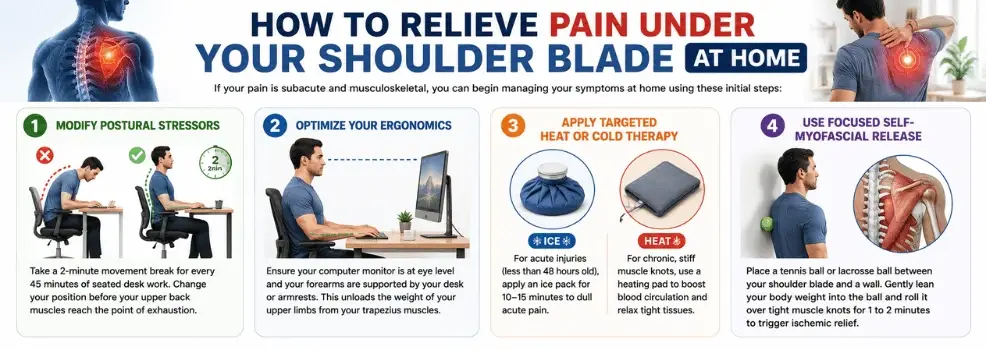
If your pain is subacute and musculoskeletal, you can begin managing your symptoms at home using these initial steps:
- Modify Postural Stressors: Take a 2-minute movement break for every 45 minutes of seated desk work. Change your position before your upper back muscles reach the point of exhaustion.
- Optimize Your Ergonomics: Ensure your computer monitor is at eye level and your forearms are supported by your desk or armrests. This unloads the weight of your upper limbs from your trapezius muscles.
- Apply Targeted Heat or Cold Therapy: For acute injuries (less than 48 hours old), apply an ice pack for 10-15 minutes to dull acute pain. For chronic, stiff muscle knots, use a heating pad to boost blood circulation and relax tight tissues.
- Use Focused Self-Myofascial Release: Place a tennis ball or lacrosse ball between your shoulder blade and a wall. Gently lean your body weight into the ball and roll it over tight muscle knots for 1 to 2 minutes to trigger ischemic relief.
How Physiotherapy Can Help Reduce Scapular Pain
When upper back pain persists for more than a couple of weeks, relying on rest alone is rarely enough. A persistent ache usually points to an underlying movement dysfunction or structural imbalance that needs expert care.
Clinical frameworks, such as those from the American Physical Therapy Association (APTA), emphasize that targeted physical therapy is highly effective for treating thoracic and scapular dysfunction. A customized treatment plan approach helps resolve symptoms by:
- Performing a Comprehensive Assessment: A professional evaluation identifies whether your pain stems from a local muscle strain, a misaligned rib, or a referred nerve root issue originating in your neck.
- Utilizing Targeted Manual Therapy: Hands-on joint mobilizations and advanced soft-tissue techniques help release stubborn muscle knots and restore normal joint play to the thoracic spine and ribs.
- Restoring Muscle Balance: A tailored exercise program strengthens the lower trapezius, serratus anterior, and rotator cuff muscles, restoring smooth, natural scapular movement.
- Providing Integrated Care: If your recovery requires deeper tissue work or spinal adjustments, your care can be integrated with specialized treatments like Massage Therapy or Chiropractic Care.
Book Your Upper Back Pain Assessment in Winnipeg
You don’t have to live with the daily distraction and drain of upper back pain. Identifying the specific mechanical and postural imbalances early can help prevent minor muscle fatigue from turning into a chronic structural issue.
At Bridgwater Physiotherapy, our clinical team performs detailed assessments to evaluate your movement patterns, isolate the root cause of your discomfort, and design a personalized treatment plan focused on long-term relief.
Frequently Asked Questions
Why Does It Hurt Under My Shoulder Blade When I Take a Deep Breath?
Pain during deep breathing is often caused by rib joint dysfunction or an intercostal muscle strain. When your lungs expand, your rib cage must expand with them; if a rib joint is restricted or inflamed, this movement triggers a sharp, localized pain.
How Long Does It Take for a Shoulder Blade Muscle Strain to Heal?
A mild to moderate muscular strain typically improves within 2 to 4 weeks when paired with activity modification and targeted mobility work. Chronic issues driven by severe postural imbalances or nerve compression may take 6 to 8 weeks of structured strengthening to fully stabilize.
Can a Problem in My Neck Cause Pain Under My Shoulder Blade?
Yes. This is a very common clinical presentation known as cervical radiculopathy. When a nerve root in the lower neck is irritated or compressed by a herniated disc, the pain signal travels down the nerve path, frequently manifesting as a deep, burning ache right along the inside edge of the shoulder blade.
Is It Better to Stretch or Strengthen a Hurting Shoulder Blade?
In the acute phase, gentle stretching and mobility exercises help reduce muscle guarding and ease discomfort. However, long-term relief requires strengthening the scapular stabilizers to prevent the muscles from fatiguing and locking up again.