Knee pain can make everyday activities like walking, climbing stairs, squatting, or getting out of a chair incredibly difficult. In many cases, targeted physiotherapy exercises help reduce pain, improve joint mobility, strengthen the muscles supporting the knee, and prevent future injuries. While the right exercises depend entirely on the root cause of your discomfort, gentle mobility work and progressive strengthening are universally recommended for many common knee conditions.
If you are struggling with a specific injury, getting a professional evaluation at a clinic specializing in Knee Pain Physiotherapy or Sports Injury Physiotherapy is the safest way to ensure your recovery stays on track. Below are 7 evidence-based exercises to help you find relief and rebuild your joint health safely at home.
Section 1: Exercises to Improve Knee Mobility & Flexibility
Before building strength, you must safely restore fluid movement within the joint capsule. These introductory movements encourage the production of synovial fluid to lubricate the joint and decompress surrounding muscles.
1. Lying Knee Bends (Heel Slides)
This foundational movement gently restores knee flexion without placing a heavy mechanical load on the joint. It is excellent for managing morning stiffness or early-stage recovery.
- How to do it: Lie flat on your back on a mat or bed with both legs straight. Slowly slide your heel toward your buttocks, bending your knee smoothly. Go only as far as comfortable; stop immediately if a sharp pain occurs. Hold for 2 seconds, then slowly slide your foot back out to the starting position.
- Volume: Complete 10 to 15 repetitions per side.
2. Hamstring Towel Stretch
The hamstring muscles run down the back of your thigh and cross the back of the knee joint. Chronic tightness here pulls directly on the joint, altering your movement mechanics.
- Best for: Tight hamstrings, mild arthritis, and patellofemoral pain.
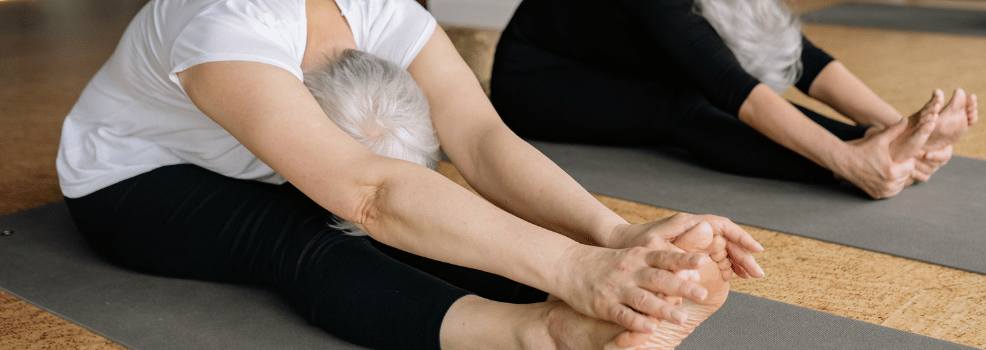
- How to do it: Lie flat on your back. Loop a long towel or rigid strap around the ball of one foot. Holding the ends of the towel, gently lift your leg toward the ceiling while keeping your knee straight. Stop when you feel a deep, comfortable pull along the back of your thigh.
- Volume: Hold the stretch for 30 seconds. Repeat 3 times per leg.
3. Standing Quadriceps Stretch
The quadriceps on the front of your thigh directly control the alignment of your kneecap. If they tighten up, they pull the kneecap forcefully against the femur.
- Best for: Runner’s knee, patellar tendinitis, and general thigh tightness.
- How to do it: Stand tall, holding onto a sturdy wall or chair for balance. Bend your right knee, bringing your heel back toward your glutes. Reach back to grasp your ankle. Gently pull your heel closer to your body. Keep your knees close together and avoid arching your lower back to maximize the stretch.
- Volume: Hold for 30 seconds. Repeat 2 to 4 times on each leg.
Section 2: Exercises to Build Knee Strength
True joint protection comes from building resilient, balanced, supportive tissue around the patella, thighs, and hips.
4. Seated Knee Extensions
This is a core clinical movement used extensively in knee arthritis treatment to safely isolate and strengthen the vastus medialis obliquus (VMO), the inner quad muscle crucial for tracking.
- How to do it: Sit upright in a supportive chair with your feet flat on the floor. Slowly straighten one knee, lifting your foot until your leg is parallel to the floor. Squeeze the muscle on top of your thigh firmly at the peak for 5 seconds, then slowly lower it back down with control.
- Volume: Complete 3 sets of 10 repetitions per leg.
5. Straight Leg Raises (SLR)
The SLR strengthens the quadriceps and hip flexors without requiring the sensitive knee joint to bend under mechanical tension.
- How to do it: Lie flat on your back. Bend your left knee, placing your left foot flat on the floor to support your lower back. Keeping your right leg completely straight, slowly lift it until your thighs are perfectly parallel. Hold for 5 seconds, then lower it with control.
- Volume: Perform 10 to 12 repetitions; complete 3 sets per side.
6. Lateral Clamshells
Knee pain is frequently a direct symptom of weak hips. This exercise strengthens the gluteus medius, which helps improve knee alignment during walking, running, and stair climbing by preventing the knee from caving inward.
- How to do it: Lie on your side with your hips stacked and knees bent at a 90-degree angle. Keeping your feet pinned firmly together, slowly raise your top knee toward the ceiling like an opening clamshell. Do not let your pelvis roll backward. Hold for 3 seconds, then lower.
- Volume: Complete 15 repetitions per side.
7. Biomechanical Mini-Squats
This functional, closed-chain movement prepares your knees for real-world demands like standing up from a low chair.
- How to do it: Stand with your feet hip-width apart, toes pointing slightly outward. Engage your core, keep your chest upright, and sit your hips back as if lowering into a chair. As you lower, keep your knees aligned over your second toe to ensure ideal joint tracking. Go down roughly 30 to 45 degrees, then drive through your heels to stand.
- Volume: Complete 3 sets of 10 repetitions.

Quick Guide: Which Exercise is Best For Your Knee Pain?
| Your Condition / Goal | Recommended Exercises |
| Knee Osteoarthritis | Heel Slides, Seated Knee Extensions |
| Runner’s Knee (Patellofemoral Pain) | Lateral Clamshells, Standing Quad Stretch |
| General Knee Weakness | Straight Leg Raises, Mini-Squats |
| Stiffness & Limited Mobility | Heel Slides, Hamstring Towel Stretch |
When Is Home Care Not Enough?
If your knee pain is mild and gradually improving, continuing with home stretching and low-impact movement is perfectly safe. However, you should transition to a professional physiotherapy assessment if your knee pain does not improve after a week of rest, or if you experience persistent joint clicking, grinding, popping, or a sensation that the knee might “give out” beneath you.
Note: Sudden, severe joint swelling, an absolute inability to bear weight on the leg, visible structural deformity, fever, or pain resulting from significant physical trauma requires urgent medical evaluation at an emergency care center.
Book Your Knee Physiotherapy Assessment in Winnipeg
If knee pain is limiting your daily activities, our physiotherapists can identify the underlying cause and design a personalized rehabilitation program based on your unique goals, symptoms, and movement patterns. Whether you are dealing with chronic arthritis or recovering from a sports injury, early intervention is key to avoiding structural compensation.
At Bridgwater Physiotherapy, our clinical team combines evidence-based manual therapy, targeted exercises, and comprehensive assessments to help restore your mobility and reduce knee pain. During your assessment, one of our skilled physiotherapists will evaluate your knee and create a personalized treatment plan based on your symptoms, goals, and movement patterns.