

Despite its size, the wrist plays a critical role in nearly every hand movement we make. This is particularly needed during sports, workouts, and routine daily activities. Whether you are gripping a racket, lifting weights, typing on a keyboard, or carrying groceries, your wrists absorb repetitive strain. This strain can gradually weaken supporting structures and reduce wrist stability.
This is why wrist physiotherapy exercises are often recommended to help improve joint control, muscle balance, and endurance. In this blog, we will explain why wrist stability matters and the common wrist injuries across activities. We will also explain how targeted wrist physiotherapy in Winnipeg can help you in racket sports, gym training, and everyday use.
Why Wrist Stability and Strength Matter in Racket Sports, Gym, or Daily Life
Clinically, the wrist functions as a bridge between the forearm and the hand, allowing power transfer and shock absorption.
- In racket sports such as tennis, badminton, or squash, rapid changes in direction and force place high demands on wrist stability.
- In the gym, poor wrist positioning during lifts like bench presses, push-ups, or deadlifts can lead to strain and inflammation.
- Even repetitive daily activities, such as phone use or prolonged computer work, contribute to cumulative stress.
A stable wrist relies on the coordinated action of muscles, tendons, ligaments, and proprioceptive feedback. When one component weakens, the joint becomes vulnerable to injuries such as tendinitis, sprains, or chronic pain.
Common Wrist Injuries Across Activities
Wrist injuries often develop gradually due to overuse rather than sudden trauma. Understanding common problems highlights the importance of preventive training. The common wrist injuries across various activities include:
- Tendinitis caused by repetitive gripping or wrist extension
- Tennis wrist is linked to improper technique or muscle imbalance
- Gym-related wrist pain from excessive loading or poor alignment
- Ligament strain from sudden twisting or impact
- Reduced grip strength due to muscle fatigue or nerve irritation
The Role of Physiotherapy in Wrist Stability & Strengthening
Wrist physiotherapy focuses on restoring strength, mobility, and neuromuscular control while respecting tissue healing timelines. Unlike generic workouts, wrist physiotherapy exercises target smaller stabilizing muscles that support joint strength.
A wrist physiotherapist in Winnipeg generally assesses your posture, grip mechanics, range of motion, and activity-specific demands before recommending exercises. This personalized approach ensures that strengthening does not overload already stressed tissues.
Preparing the Wrist: Warm-Up and Mobility
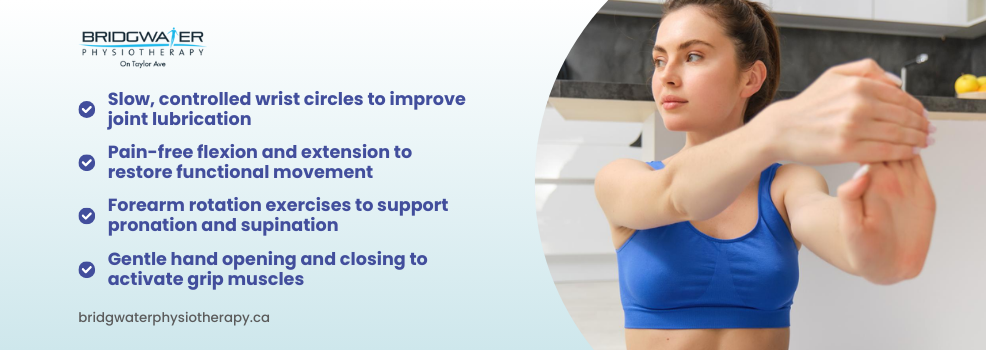
Under a physiotherapist’s guidance, warm-up and mobility work may include:
- Slow, controlled wrist circles to improve joint lubrication
- Pain-free flexion and extension to restore functional movement
- Forearm rotation exercises to support pronation and supination
- Gentle hand opening and closing to activate grip muscles
These movements are selected and progressed based on individual tolerance, ensuring the wrist is ready for more demanding tasks.
Grip Strength and Forearm Conditioning for Wrist Stability
Grip strength plays a major role in wrist stability, and physiotherapists regularly assess grip function when treating wrist issues. Weak or fatigued grip muscles can overload the wrist joint, increasing the risk of injury. Physiotherapists may introduce:
- Softball or therapy putty squeezing to build controlled grip strength
- Towel wringing exercises to strengthen forearm muscles
- Farmer’s carries with emphasis on neutral wrist positioning
- Finger extension work using resistance bands to balance grip forces
Improving grip strength under physiotherapy supervision helps maintain proper wrist alignment during lifting, sports, and daily activities.
Proprioception and Wrist Control Training
Physiotherapists also address proprioception, the wrist’s ability to sense its position and respond to movement. This is especially important for injury prevention in fast-paced or unpredictable activities. Proprioceptive training guided by a physiotherapist may include:
- Weight-bearing wrist shifts on stable or slightly unstable surfaces
- Balance-based exercises using soft mats or controlled equipment
- Catch-and-release drills to improve reaction and coordination
- Closed-chain movements, such as wall-supported wrist loading
These wrist physiotherapy exercises prevent the wrist from adapting to sudden changes in force, improving joint control.
Sport-Specific Wrist Rehabilitation and Conditioning
For athletes, physiotherapists design wrist programs that reflect the exact demands of the sport. Racket sports place high stress on the wrist during rapid acceleration and deceleration, as well as during repeated impacts. A wrist physiotherapist in Winnipeg may prescribe:
- Eccentric wrist strengthening to control follow-through movements
- Resistance band drills that mimic racket strokes
- Rotational forearm exercises to support spin and directional control
- Endurance-based training to reduce fatigue during long sessions
Athletes working with wrist physiotherapists often experience improved performance consistency and fewer interruptions due to wrist pain.
Wrist Stability Support for Gym Training
In gym environments, wrist injuries frequently result from excessive loading or poor positioning. Physiotherapists guide clients on safe wrist mechanics while strengthening the joint for resistance training. Wrist physiotherapy in Winnipeg for this may include:
- Guiding neutral wrist positioning during planks and push-ups
- Structured load progression to avoid sudden overload
- Improving forearm engagement during pressing and pulling exercises
- Programming adequate rest to prevent overuse injuries
These wrist physiotherapy exercises help prevent minor discomfort from developing into chronic wrist problems.
Additional Wrist Care Tips Based on Physiotherapy Guidance
Physiotherapists also help patients manage wrist strain outside of sports and exercise. Daily habits often contribute significantly to ongoing wrist pain. Physiotherapy guidance may focus on:
- Maintaining neutral wrist posture during typing or mobile phone use
- Encouraging regular breaks from repetitive hand tasks
- Recommending ergonomic adjustments for workstations
- Including brief mobility exercises in daily routines
These practical strategies support long-term wrist health and complement structured wrist physiotherapy programs.
Conclusion
Wrist stability and strength are essential for injury prevention and long-term joint health. The wrist is constantly exposed to repetitive stress during sports, gym training, and daily activities. Targeted wrist physiotherapy exercises help maintain proper alignment, reduce overload, and improve endurance.
At Bridgwater Physiotherapy, our experienced physiotherapists regularly treat wrist conditions caused by repetitive strain, workplace demands, and sports participation. Our team focuses on accurate assessment, evidence-based treatment, and targeted wrist physiotherapy exercises to support safe recovery. Contact us today!